EFL Freshmen’s Emotions and Emotion Regulation Strategies in AI-Supported Collaborative Argumentative Essay Writing
Applied Research on English Language , Vol. 15 (1) · 2026
Summary
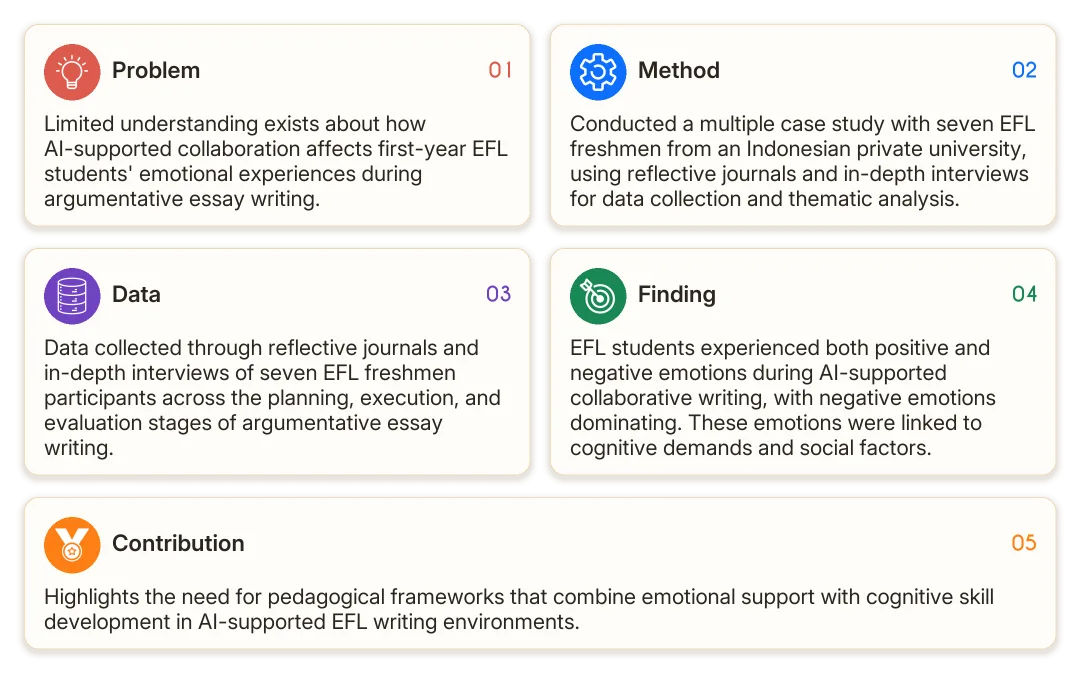
The study underscores the importance of integrating emotional support into pedagogical frameworks to promote equitable and reflective collaboration in AI-supported EFL writing.
Details
Abstract
The integration of artificial intelligence (AI) in higher education has transformed writing instruction. Still, little is known about how AI-supported collaboration shapes first-year students’ emotional experiences during argumentative essay writing. Emotions influence students’ engagement, idea negotiation, and overall writing performance, particularly in the English as a Foreign Language (EFL) context. This study investigates EFL freshmen’s emotions and emotion regulation strategies in AI-supported collaborative argumentative essay writing across the stages of planning, execution, and evaluation. Using a multiple case study design, seven EFL freshmen from a private Indonesian university participated. Data were gathered through reflective journals and in-depth interviews, and were analyzed thematically. The findings show that students experienced both positive and negative emotions throughout the writing process, with negative emotions, such as anxiety, confusion, overwhelm, and stress, being more dominant. These emotions were linked to cognitive demands, including topic selection, evidence integration, and revision, as well as social factors such as unequal contribution and fear of negative judgment. Although AI tools helped with linguistic accuracy and text organization, they did not fully address deeper emotional and motivational challenges. Students used various regulation strategies, including attention deployment (seeking online sources), cognitive change (breaking tasks into smaller ones, positive self-talk, task prioritization), and response modulation (taking breaks, consulting AI tools). The study highlights the need for pedagogical frameworks that combine emotional support with cognitive skill development to promote equitable and reflective collaboration in AI-supported EFL writing. © University of Isfahan.
Affiliations
The State University of Malang, Malang, Indonesia; Teknokrat Indonesia University, Indonesia; Universiti Sultan Zainal Abidin, Malaysia