Development and validation of the student nature connection scale for assessing pro-biodiversity conservation behavior among Indonesian high school students
Social Sciences and Humanities Open , Vol. 14 · 2026
Summary
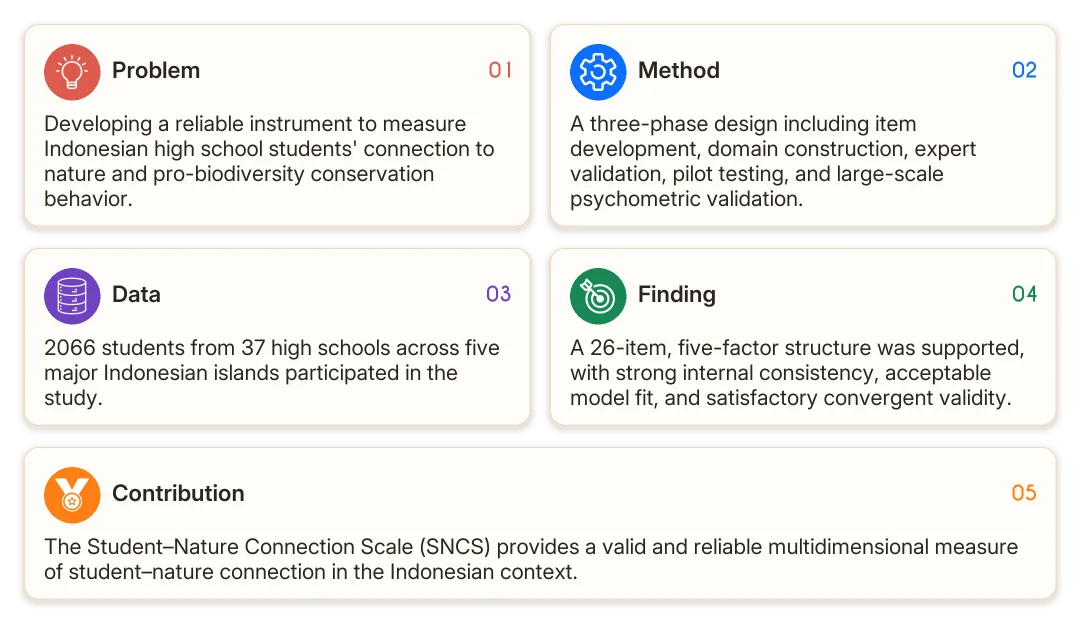
These findings provide preliminary evidence that the SNCS is a valid and reliable multidimensional measure of student–nature connection in the Indonesian context.
Details
Abstract
This study developed and preliminarily validated the Student–Nature Connection Scale (SNCS) as a contextually grounded instrument for assessing Indonesian high school students’ connection to nature in relation to pro-biodiversity conservation behaviour. A total of 2066 students from 37 public and private high schools across five major Indonesian islands participated in the study. The research employed a three-phase design involving item development and domain construction, expert validation and pilot testing, and large-scale psychometric validation through Exploratory and Confirmatory Factor Analyses. The results supported a final 26-item, five-factor structure comprising affective, cognitive, pro-environmental behaviour, outdoor recreation behaviour, and biophilia dimensions. The scale demonstrated strong internal consistency (Cronbach's α = 0.96), acceptable model fit (RMSEA = .068; CFI = .922), and satisfactory convergent validity. These findings provide preliminary evidence that the SNCS is a valid and reliable multidimensional measure of student–nature connection in the Indonesian context. Overall, the SNCS offers a promising tool for research and educational practice by enabling the assessment of student–nature connection as a foundation for biodiversity-oriented learning and conservation-related educational initiatives. © 2026 The Authors.
Affiliations
Department of Biology, Universitas Negeri Malang, Malang, Indonesia; Graduate Institute of Science Education, National Taiwan Normal University, Taipei, Taiwan