A Data-Driven Exploratory Analysis of the Alcohol-Harm Paradox in South-East Wales
International Journal of Environmental Research and Public Health , Vol. 23 (8) · 2026
Summary
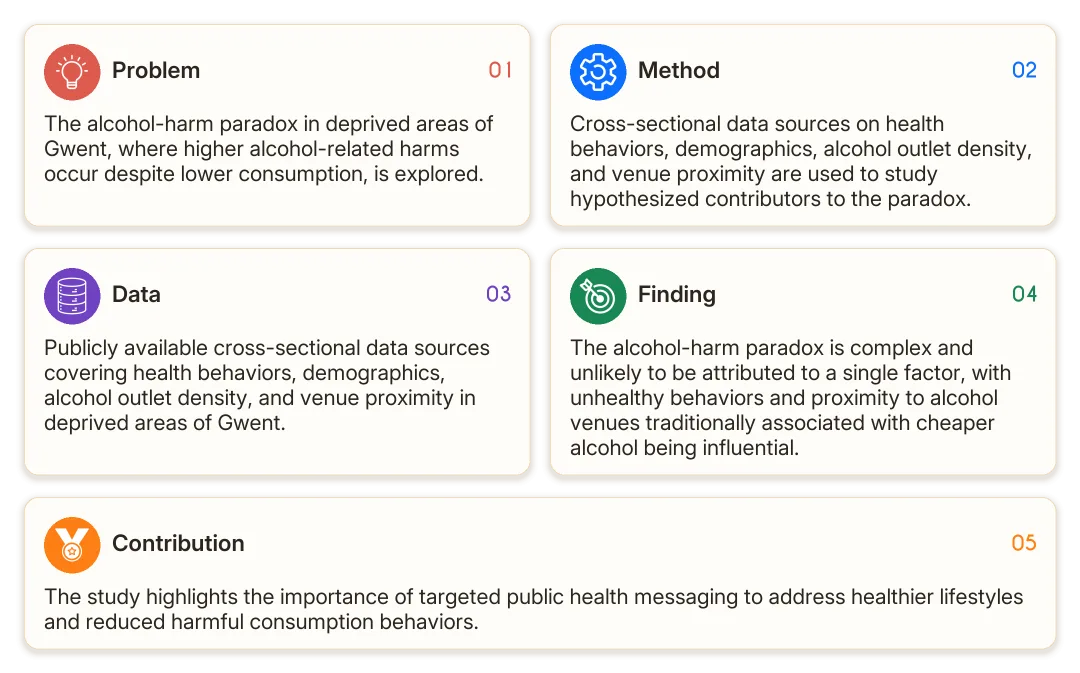
Elevated prevalence of unhealthy behaviors in more deprived areas and proximity to alcohol venues traditionally associated with cheaper alcohol emerged as potential influential factors.
Details
Abstract
Alcohol consumption contributes substantially to global morbidity and mortality. The alcohol-harm paradox describes the phenomenon where more deprived areas experience higher levels of alcohol-related harms despite reporting similar or lower levels of alcohol consumption compared to less deprived areas. This paradox is particularly evident in Gwent, South-East Wales, where more deprived areas experience greater levels of harms despite having lower annual alcohol consumption. This research aims to explore the impacts of various hypothesised contributors to the alcohol-harm paradox in Gwent. Publicly available cross-sectional data sources are used to explore health behaviours, demographics, alcohol outlet density, and proximity to alcohol-related venues. Factors are studied in relation to both annual alcohol consumption and binge drinking prevalence. Alcohol-related harms are considered in terms of alcohol-specific deaths and alcohol-attributable hospital admissions. The findings reinforce the known complexity of the alcohol-harm paradox, and suggest that it is unlikely to be attributable to a single factor. Elevated prevalence of unhealthy behaviours in more deprived areas and proximity to alcohol venues traditionally associated with cheaper alcohol emerged as potential influential factors. These exploratory findings highlight the importance of targeted public health messaging addressing an overall healthier lifestyle and less harmful consumption behaviours, to reduce alcohol-related health inequalities. © 2026 by the authors.
Affiliations
School of Mathematics, Cardiff University, Cardiff, CF24 4AG, United Kingdom; School of Business and Health, Aalen University, Aalen, 73430, Germany; Department of Mathematics, Universitas Negeri Malang, Jawa Timur 65145, Malang, Indonesia