Decoding Wolffia: A Predictive Model for Duckweed Growth and Nutrient Uptake for Resource Recovery from Wastewater in Tropical Countries
ACS ES and T Engineering , Vol. 6 (9) · 2026
Summary
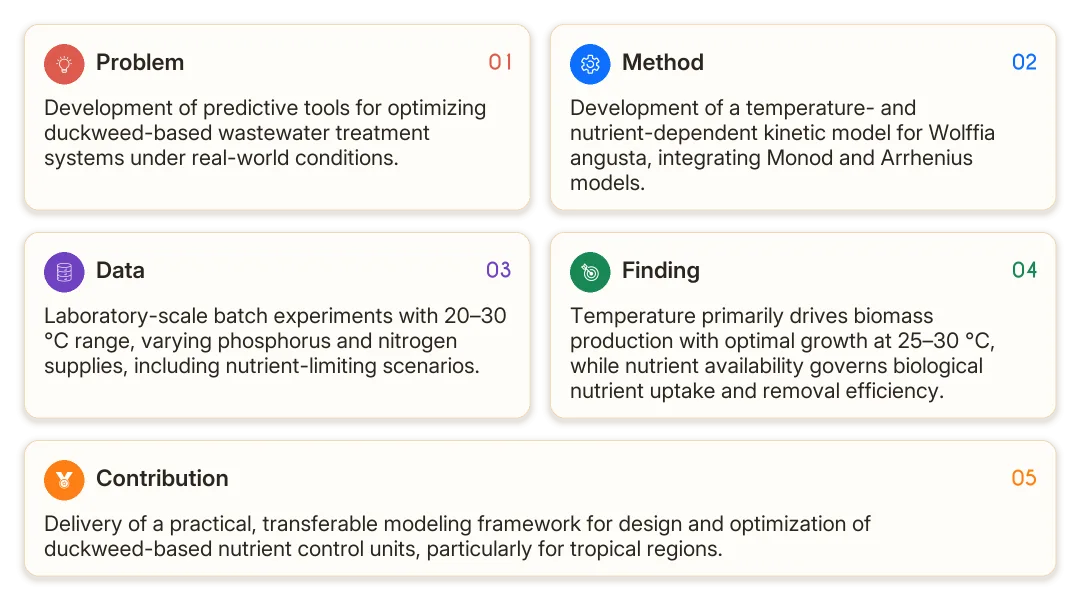
The model was applied to simulate a duckweed-based pond system to polish effluent from a hybrid anaerobic baffled reactor (HyABR) processing domestic wastewater under tropical conditions.
Details
Abstract
Duckweed-based wastewater treatment systems have attracted increasing attention for sustainable water pollution control, yet predictive tools to optimize their operation under real-world conditions remain limited. Here, we develop and validate a temperature- and nutrient-dependent kinetic model for the duckweed species Wolffia angusta, integrating nutrient limitation (Monod model), temperature dependence (Arrhenius model) and internal nutrient reserve dynamics. The model was parametrized and validated through laboratory-scale batch experiments (20–30 °C), in small cylindrical plastic vessels, under varying phosphorus and nitrogen supplies, including nutrient-limiting scenarios. Temperature predominantly drives biomass production, with optimal growth observed at 25–30 °C (maximum relative growth rate of 0.427 d–1), while nutrient availability more strongly governs biological nutrient uptake and removal efficiency. Maximum nutrient removal rates reached 6.85 mg N L–1 d–1 and 1.85 mg P L–1 d–1 under nutrient-replete conditions. Biomass accumulation increases at the higher end of optimum temperature values, but specific nitrogen uptake rates decrease, indicating metabolic constraints. Model calibration markedly improved predictive accuracy (R2 > 0.9; RPD > 2), even under nutrient-limited conditions. The model was applied to simulate a duckweed-based pond systems to polish the effluent from a hybrid anaerobic baffled reactor (HyABR) processing domestic wastewater under tropical conditions (Indonesia). Beyond predicting effluent nutrient concentrations, the model was used as a process design tool to optimize system configuration to meet local effluent discharge consents. Simulations showed that increasing the number of duckweed ponds in series reduces total hydraulic retention time and total land area while lowering per-pond productivity, with an optimal configuration of two to three ponds balancing treatment performance and resource recovery. This work advances the mechanistic understanding of Wolffia’s growth and nutrient uptake, and delivers a practical, transferable modeling framework for design and optimization of duckweed-based nutrient control units for decentralised wastewater treatment, particularly in tropical regions. The approach represents a significant step toward integrating nature-based systems into circular, sustainable water management strategies. © 2026 The Authors. Published by American Chemical Society.
Affiliations
BioResource Systems Research Group, School of Civil Engineering, University of Leeds, Leeds, LS2 9JT, United Kingdom; School of Molecular and Cellular Biology, Faculty of Biological Sciences, University of Leeds, Leeds, LS2 9JT, United Kingdom; Departamento de Ingeniería Química, Universidad Nacional de Colombia, Campus La Nubia, Manizales, 170003, Colombia; Environmental Engineering Study Programme, Department of Civil Engineering and Planning, Faculty of Engineering, Universitas Negeri Malang, Malang, 65145, Indonesia