Higher education management base on Tri Hita Karana: Case study hindu higher education instution
International Journal of Mechanical Engineering and Technology , Vol. 9 (8) · 2018
Summary
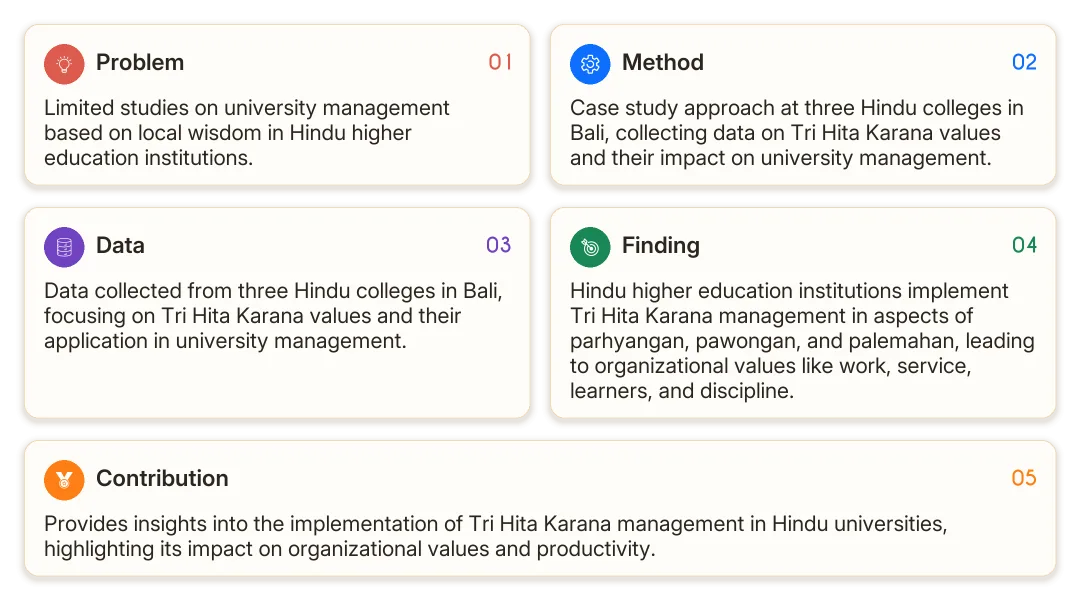
The implementation of Tri Hita Karana management in Hindu higher education organizations produces organizational values such as: (1) Value of Work, (2) Value of Service, (3) Value of Learners, and (4) Value of Discipline.
Details
Abstract
Management based on local wisdom is one of the most appropriate management patterns applied to universities, its close proximity to the lifestyle of the surrounding community. However, very few studies have examined the management pattern of higher education in accordance with the noble values of the community where the college is founded. This study aims to describe the implementation of Tri Hita Karanabased management functions as local wisdom in Hindu universities. The method used to achieve this goal is a case study carried out at three Hindu colleges in the province of Bali, to explore data on Tri Hita Karana values related to the implementation of higher education based on local wisdom. The results of this study indicate that STKIP Hinduism Singaraja, IHDN Denpasar, and UNHI Denpasar, carry out university management based on the value of Tri Hita Karana in maintaining the harmony of the organization. The implementation of Tri Hita Karana management in Hindu higher education organizations is implemented in the aspects of parhyangan, pawongan and palemahan (religious, sociological and ecological). These three aspects are interrelated, this shows that these aspects cannot be separated in the implementation of Tri Hita Karana management in Hindu universities. With harmony based on Tri Hita Karana it produces organizational values such as: (1) Value of Work, (2) Value of Service, (3) Value of Learners and (4) Value of Discipline. So with the character and value of the organization productivity and quality of the organization. © 2018 IAEME Publication.
Affiliations
Post-Graduate Program, State University of Malang, Malang City, East Java, Indonesia