Effects of the Annealing Temperature on the Structure Evolution and Antifungal Performance of TiO2/Fe3O4Nanocomposites Manufactured from Natural Sand
Nano , Vol. 16 (2) · 2021
Summary
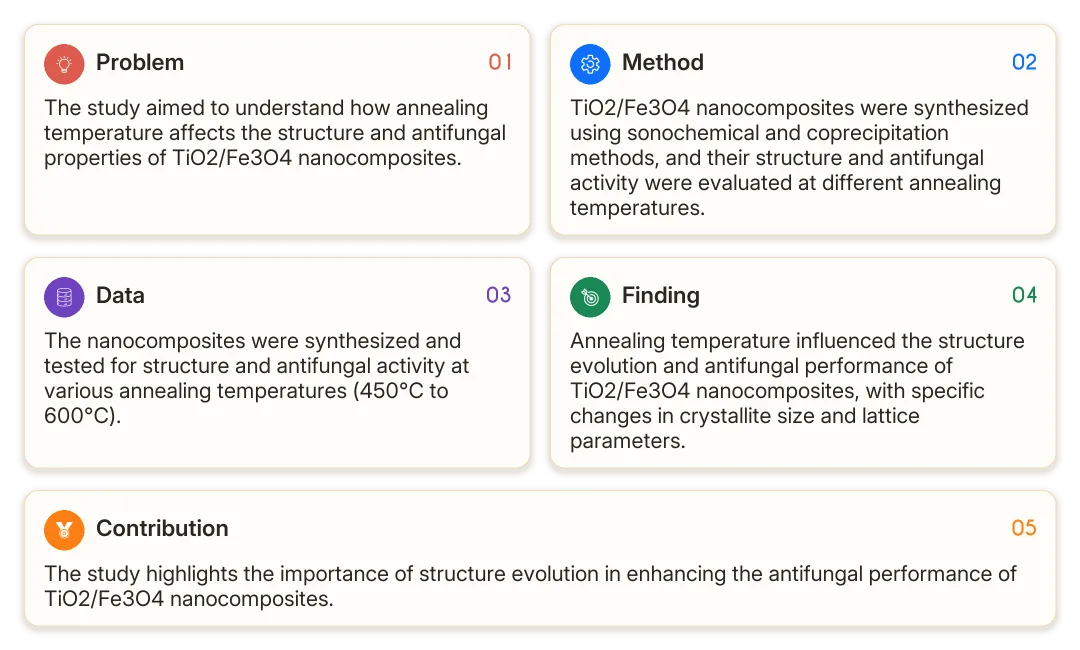
The antifungal activity of TiO2/Fe3O4 nanocomposites was superior to that of their individual components, demonstrating the synergistic effect of structure evolution.
Details
Abstract
This study investigated the effects of annealing temperature on the structure evolution and antifungal performance of TiO2/Fe3O4 nanocomposites. The TiO2/Fe3O4 nanocomposites were fabricated through a combination of sonochemical and coprecipitation routes. The TiO2 structure evolved from an amorphous phase to a crystalline anatase phase starting at an annealing temperature of 450°C while Fe3O4 evolved to γ-Fe2O3 and α-Fe2O3 starting at an annealing temperature of 600°C. The increases in the crystallite sizes and lattice parameters were also identified because of the increase in the annealing temperature. The TiO2/Fe3O4 nanocomposites tended to agglomerate due to van der Waals forces. The molecular structural dynamics of TiO2/Fe3O4 nanocomposites were also studied by infrared spectroscopy within the wavenumber range of 400-4000cm-1. The antifungal activity of TiO2/Fe3O4 nanocomposites was better than those of individual TiO2 and Fe3O4. These results showed that structure evolution plays an essential role in the antifungal performance of TiO2/Fe3O4 nanocomposites. © 2021 World Scientific Publishing Company.
Affiliations
Department of Physics, Faculty of Mathematics and Natural Sciences, Universitas Negeri Malang, Jl. Semarang, No. 5, Malang, 65145, Indonesia; Department of Biology, Faculty of Mathematics and Natural Sciences, Universitas Negeri Malang, Jl. Semarang, No. 5, Malang, 65145, Indonesia; Synchrotron Light Research Institute, 111 University Avenue, Nakhon Ratchasima, 30000, Thailand