The effect of STEM-based phenomenon learning on improving students' correlational reasoning
AIP Conference Proceedings , Vol. 2330 · 2021
Summary
The most significant obstacle for students when applying correlational reasoning is the failure to involve the whole variables related to a phenomenon.
Details
Abstract
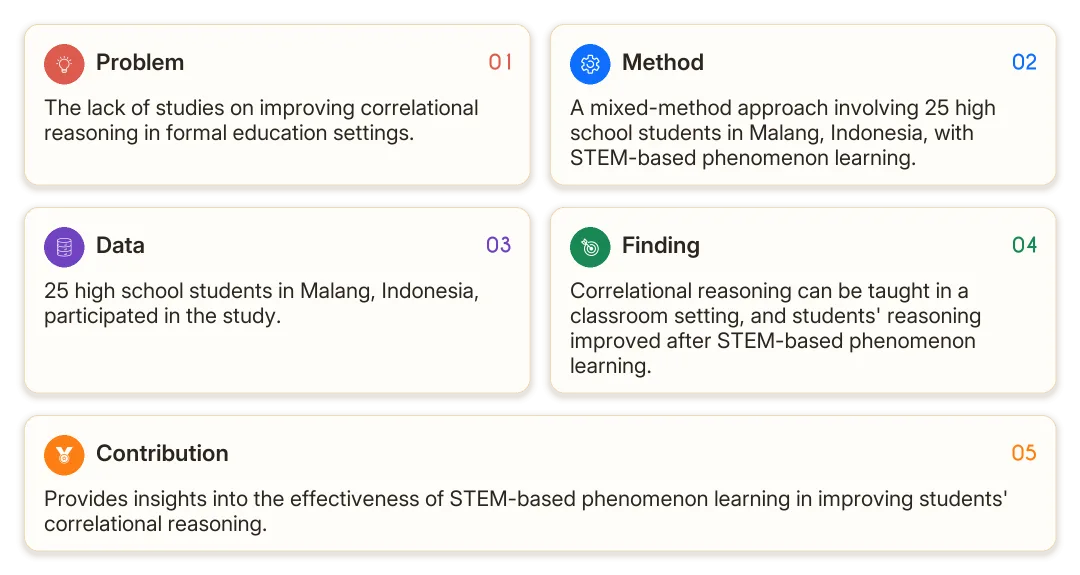
Correlational reasoning is a crucial skill for students in their daily lives. Correlational reasoning, therefore, should be taught in formal schools. However, a study about the improvement of correlational reasoning in instruction is still rarely disclosed. This study aims to explore the change in students' correlational reasoning through STEM-based phenomenon learning. This study used a mixed-method approach involving 25 high school students in Malang, Indonesia. The result of this study showed that correlational reasoning could be taught in a classroom setting. Students' correlational reasoning was improved after experiencing STEM-based phenomenon learning. The dominance is that students are still at level 2 - students show answers but are not related to each other, and level 3 - student explanations are only appropriate for one relationship. The study also showed that the most significant obstacles of students when they applied correlational reasoning was the failure to involve the whole variables related to a phenomenon. For further research, it is recommended to implement STEM-based phenomenon learning for longer durations. © 2021 Author(s).
Affiliations
Department of Physics, Faculty of Mathematics and Sciences, Universitas Negeri Malang, Jl. Semarang No. 5, Malang, 65145, Indonesia