Nanostructure, porosity and tensile strength of PVA/Hydroxyapatite composite nanofiber for bone tissue engineering
Materials Today: Proceedings , Vol. 44 · 2020
Summary
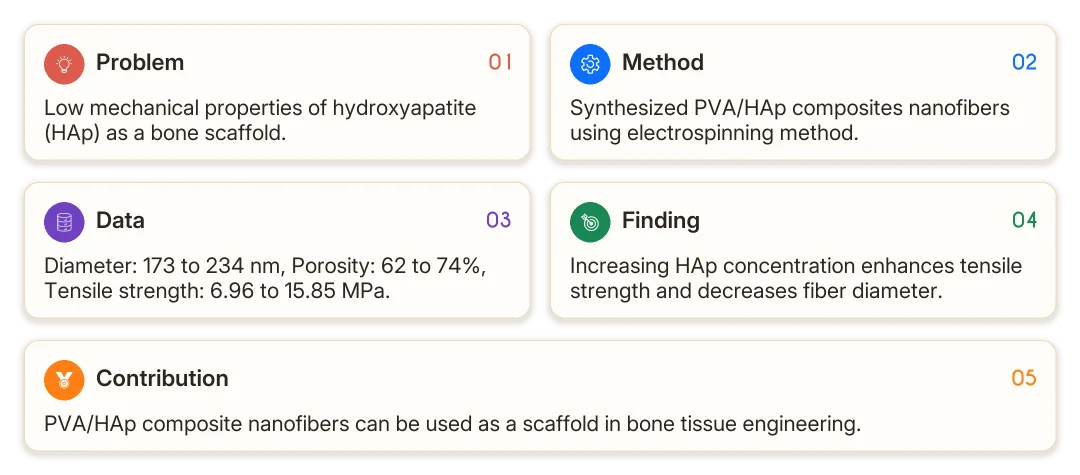
The tensile strength of PVA/HAp composite nanofibers increased with higher HAp concentration, as evidenced by SEM.
Details
Abstract
Hydroxyapatite [HAp, Ca10(PO4)6(OH)2] was successfully synthesized using natural minerals, precisely limestone from Druju Indonesia. As a bone scaffold compound, HAp has a weakness of low mechanical properties therefore it needs to be mixed with polymeric materials, such as polyvinyl alcohol (PVA) to improve its mechanical properties. The PVA/HAp composites nanofiber have successfully synthesized using the electrospinning method and analyzed including nanostructure, porosity and tensile strength of nanofiber. The diameter of PVA/HAp composites nanofiber in 173 to 234 nm, porosity in 62 to 74%, and tensile strength in 6.96 to 15.85 MPa. Increasing of HAp cocentrasion increase of tensile strength, SEM showed an increase in HAp concentration (0%-20%) causing a decrease in the average diameter of the fiber. The characteristics of PVA/HAp composite nanofiber can be applied as a scaffold in bone tissue engineering. © 2020 Elsevier Ltd. All rights reserved.
Affiliations
Department of Physics, Universitas Brawijaya, Jl. Veteran, Malang, 65145, Indonesia; Department of Physics, Universitas Negeri Malang, Jl. Semarang 5, Malang, 65145, Indonesia