Fibrillation effect on bacterial cellulose properties after freeze-drying
AIP Conference Proceedings , Vol. 2489 · 2022
Summary
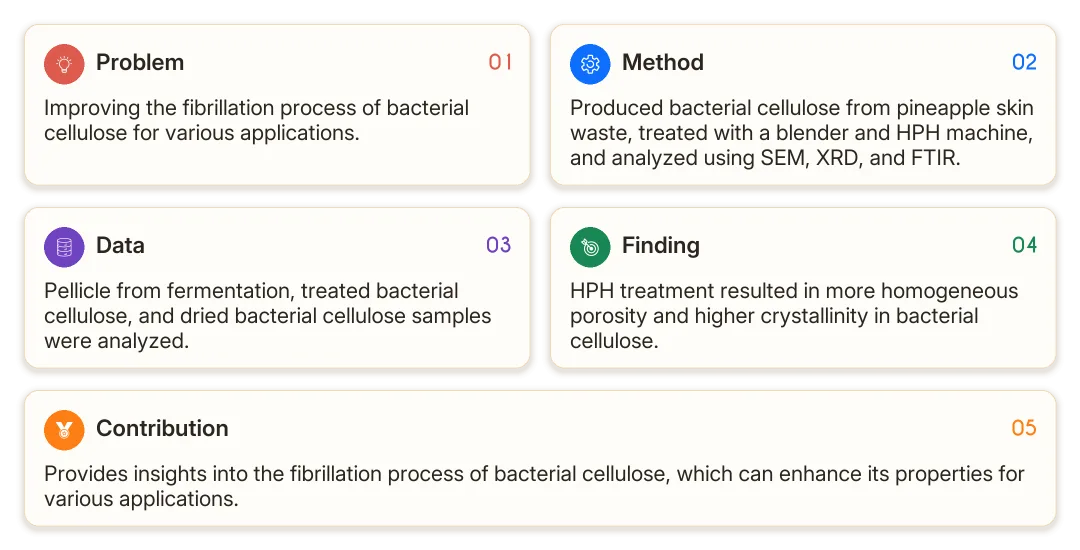
The fibrillation process did not alter the bonds of bacterial cellulose, while HPH treatment improved its crystallinity and porosity.
Details
Abstract
Bacterial cellulose has many advantages when applied in various fields, such as medic. This research reported the fibrillation process effect on bacterial cellulose using a blender and HPH on bacterial cellulose produced from pineapple skin waste. The produced pellicle after the fermentation process was cleaned and received treatment from a blender and a High-Pressure Homogenization (HPH) machine. After that, the bacterial cellulose was dried using a freeze-drying method. Use scanning electron microscopy (SEM), X-ray diffraction (XRD), and Fourier transform infrared (FTIR) to observe bacterial cellulose. The SEM results showed that the HPH treatment created a more homogenous porosity in the bacterial cellulose. The XRD result presented that similar crystal positions were found at 14°, 16°, and 22°. The HPH treatment produced a higher crystallinity value. The FTIR test showed that the fibrillation process did not change the bonds of bacterial cellulose. © 2022 Author(s).
Affiliations
Department of Mechanical Engineering, Faculty of Engineering, Universitas Negeri Malang, Jl. Semarang 5, Malang, 65145, Indonesia; Center of Excellence for Cellulose Composite (CECCom), Department of Mechanical Engineering, Universitas Negeri Malang, Jl. Semarang 5, Malang, 65145, Indonesia; Department of Waters Resources Management, Faculty of Fisheries and Marine Sciences, Universitas Brawijaya, Jl. Veteran, Malang, 65415, Indonesia