Mode-locked operation in thulium-holmium doped fiber laser based on Cr2AlC MAX phase SA coated arc-shaped fiber
Optical and Quantum Electronics , Vol. 55 (3) · 2023
Summary
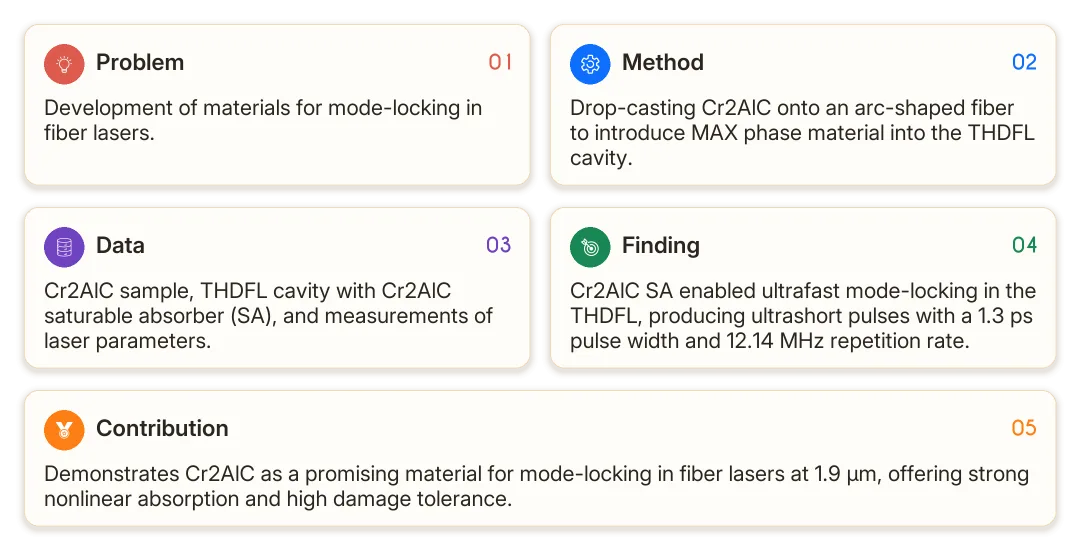
Cr2AlC saturable absorber was found to be a promising material for initiating mode-locking in fiber lasers at 1.9 μm.
Details
Abstract
This study presents the application of MAX phase material as a mode-locker in the thulium-holmium-doped fiber laser (THDFL) cavity in generating ultrashort pulses. MAX phase materials were rapidly developed for applications in the pulsed laser field due to their promising properties and characteristics, such as strong nonlinear absorption, high damage tolerance, and good thermal and electrical conductivities. Chromium Aluminum Carbide (Cr2AlC) MAX phase sample was explicitly introduced into the cavity by drop-casting the Cr2AlC onto the fabricated arc-shaped fiber. As a result, an ultrafast mode-locking laser system was achieved utilizing a Cr2AlC saturable absorber (SA) at a pump power of 115.8 mW, having a central wavelength of 1908.58 nm. The spectral bandwidth obtained was 3 nm, and a measured pulse repetition rate and pulse width of 12.14 MHz and 1.3 ps, respectively. The results indicate that Cr2AlC SA is a promising material to be used as a passive SA to initiate the mode-locking generation of fiber laser in the 1.9 μm band. © 2023, The Author(s), under exclusive licence to Springer Science+Business Media, LLC, part of Springer Nature.
Affiliations
Photonics Research Centre, Universiti Malaya, Kuala Lumpur, 50603, Malaysia; Department of Physics, Faculty of Science, Universiti Malaya, Kuala Lumpur, 50603, Malaysia; Department of Physics, Faculty of Mathematics and Natural Sciences, Universitas Negeri Malang, Jalan Semarang 5, Malang, 65145, Indonesia; Department of Physics, Faculty of Science and Technology, Universitas Airlangga, Surabaya, 60115, Indonesia