Direct Current Simulation using 3D Finite Element Method in the Acrylic Box for Dipole-Dipole Electrode Configuration
AIP Conference Proceedings , Vol. 2748 · 2023
Summary
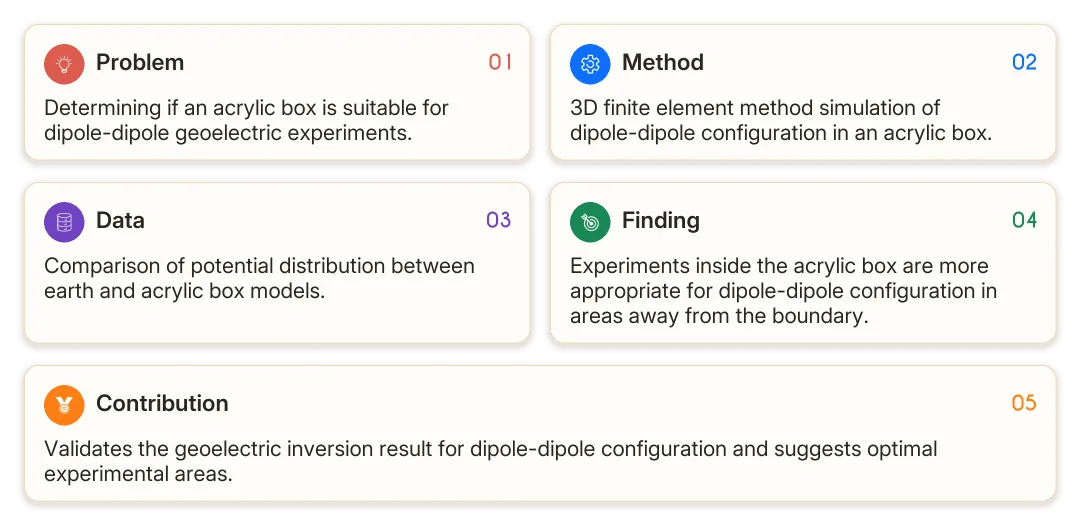
The simulation results indicate that experiments inside the acrylic box are more suitable for dipole-dipole configuration in areas away from the boundary.
Details
Abstract
The simulation direct current resistivity for dipole-dipole configuration in an acrylic box has been done using 3D finite element method. The purpose of the simulation is to know the appropriateness of an acrylic box for experiments or to validate the geoelectric inversion result for dipole-dipole configuration. The simulation is done by comparing the potential distribution between the earth model and the acrylic box model. The simulation results show that the experiment inside the acrylic box for dipole-dipole configuration is better to be done only on an area on the straight-line two electrodes and not near the boundary. © 2023 American Institute of Physics Inc.. All rights reserved.
Affiliations
Department of Physics, Universitas Negeri Malang, Malang, Indonesia; School of Physics, Universiti Sains Malaysia, Penang, 11800, Malaysia