Problem-solving: Growth of Students’ Mathematical Understanding in Producing Original Solutions
Mathematics Teaching-Research Journal , Vol. 15 (3) · 2023
Summary
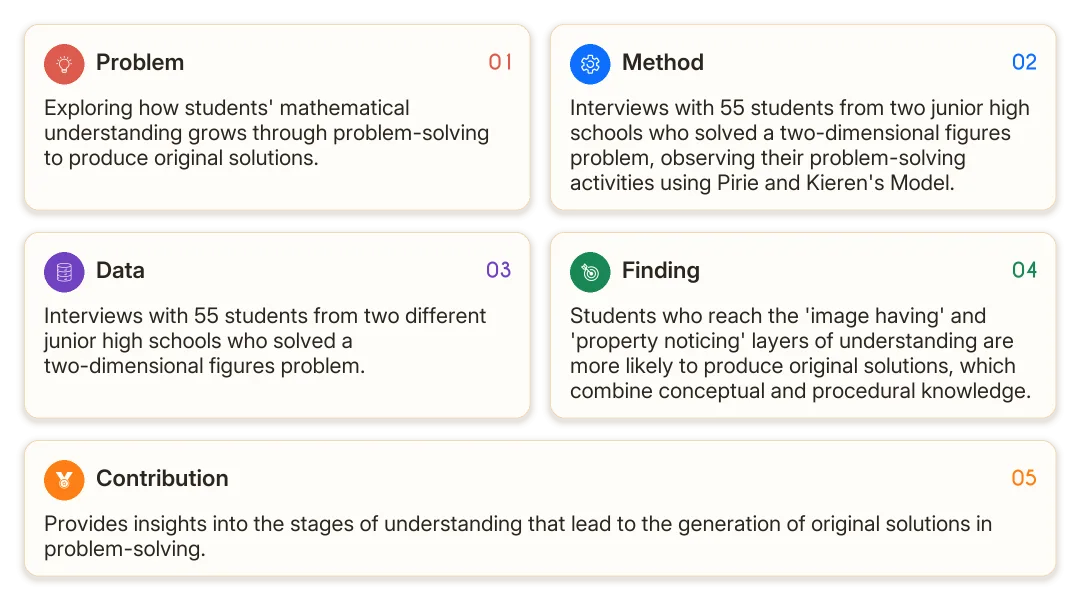
The original ideas combined with conceptual and procedural knowledge can formally support the presence of an original solution.
Details
Abstract
Students’ deep understanding of problem-solving can stimulate the presence of original solutions. This statement led this present study to explore the growth of students’ mathematical understanding in producing original solutions through problem-solving. Fifty-five students, from two different junior high schools, are solving a two-dimensional figures problem. Students who produce original solutions are interviewed to investigate their growth in mathematical understanding when generating their solutions. The original solution indicates that the answer fulfills the three aspects: different, unique, and correct. The study observes students’ activities, both ‘acting’ and ‘expressing’, which refers to layers of understanding of Pirie and Kieren’s Model. ‘Acting’ and ‘expressing’ were observed to investigate the movement of students’ understanding in solving-problem. Students whose understanding grows to the layers of ‘image making’ and ‘image having’ will come up with original ideas. The ideas become more complex as students’ understanding grows to the ‘property noticing’ layer. Besides, the original ideas combined with conceptual and procedural knowledge can formally support the presence of an original solution. Students produce original solutions when their understanding has reached the layers of ‘formalizing’ and ‘observing’. © 2023 City University of New York.
Affiliations
Universitas Negeri Malang, Indonesia; Universitas Muhammadiyah, Malang, Indonesia