Performance stability of porous silicon solar cells using reduced graphene oxide for applications in harsh environments
Optics Communications , Vol. 559 · 2024
Summary
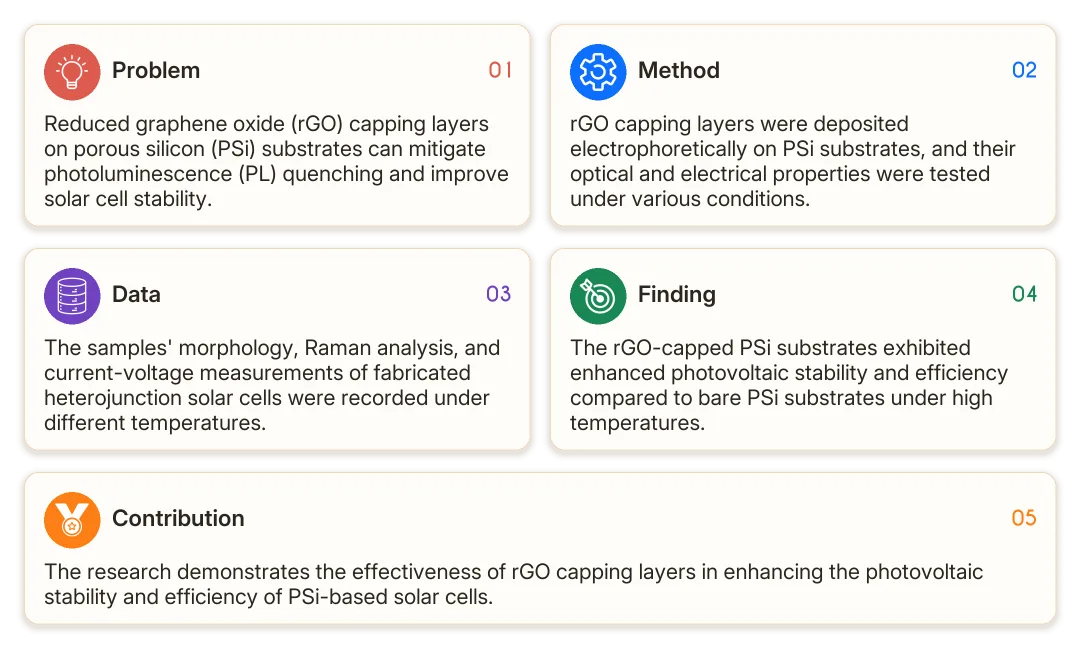
The photovoltaic stability of PSi-based solar cells was improved by the deposition of rGO capping layers, which mitigated the reduction in efficiency caused by temperature-induced changes in PSi surface terminations.
Details
Abstract
The impact of graphene on the photovoltaic stability of solar cells made of porous silicon (PSi) is discussed in this research. Here, reduced graphene oxide (rGO) capping layers electrophoretically deposited on PSi substrates were used to regulate the photoluminescence (PL) quenching of the PSi substrates. The samples' morphology showed that after graphene transfer, the porosity structure remained unaltered, and rGO layers completely covered the PSi surface. The rGO layers were successfully deposited on PSi substrates, according to the Raman analysis of the rGO/PSi, which revealed two prominent peaks corresponding to the G and D graphene bands. Additionally, the D-mode intensity was higher than the G-band intensity, showing that the deposited rGO layers had fewer structural defects and irregularities. The stability of the optical properties of PSi substrates was tested by comparing the PL spectra before and after graphene deposition. The findings demonstrated that the PL quenching of rGO-capped PSi structure was mitigated even after prolonged exposure to laser light. Therefore, the optical consistency of PSi samples was enhanced through deposition of graphene layers. Then, bare and rGO-covered PSi substrates were used to fabricate heterojunction solar cells, and their current-voltage results were measured under a solar light simulator at various temperatures. The optoelectrical tests showed that the availability of unstable species, such as hydrogen bonds on the PSi surface, caused a reduction in the efficiency of bare PSi devices at high temperatures. These terminations changed due to temperature changes, which decreased the photovoltaic performance of PSi substrates. This deterioration was moderated when graphene was transferred, which improved the photovoltaic stability of PSi-based solar cells. The rGO capping layer increased the electrical stability of fabricated solar cell based on PSi substrate during temperature changes. © 2024 Elsevier B.V.
Affiliations
Photonics Research Centre, Universiti Malaya, Kuala Lumpur, 50603, Malaysia; Department of Physics, Faculty of Science, Universiti Malaya, Kuala Lumpur, 50603, Malaysia; Universiti Kuala Lumpur British Malaysian Institute (UniKL BMI), Batu 8, Jln Sungai Pusu, Selangor, 53100, Malaysia; Department of Physics, Faculty of Mathematics and Natural Sciences, Universitas Negeri Malang, Jalan Semarang 5, Malang, 65145, Indonesia; Materials and Energy Research Center, Karaj, 31787-316, Iran