Family-Centered Care Experiences in Elderly with Chronic Diseases in Communities: Qualitative Study of Patients, Families, Nurses, and Volunteers
Health Equity , Vol. 8 (1) · 2024
Summary
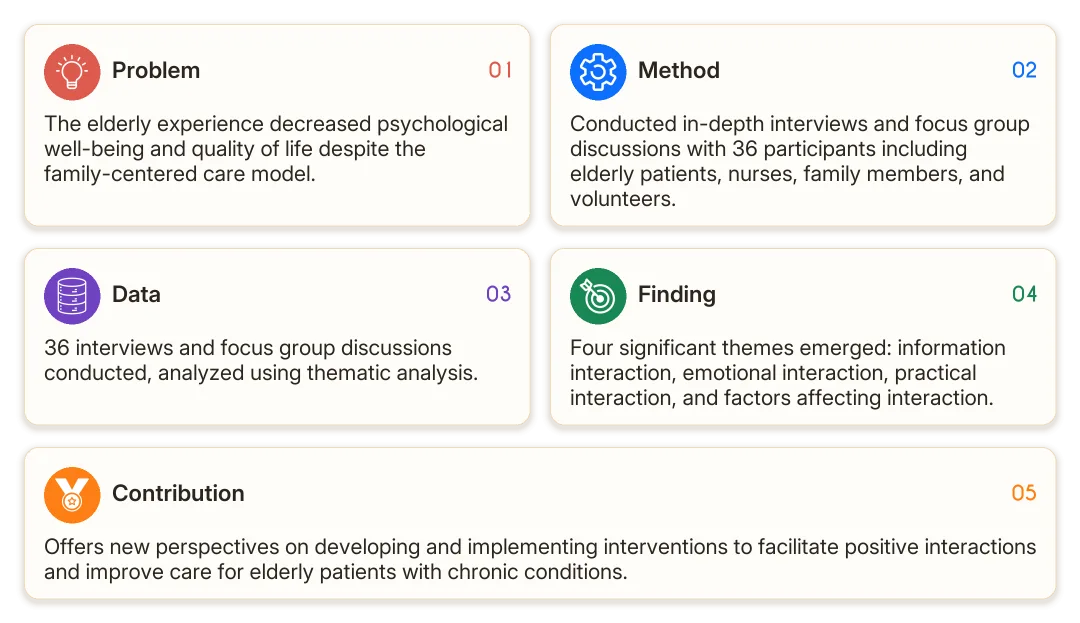
These insights provide a fresh perspective on how to develop and implement effective interventions in this context.
Details
Abstract
Introduction: The family, at community, must be an important part of elderly care. However, most of the elderly experience a decrease in psychological well-being and quality of life. This is not in accordance with the concept of the family-centered care (FCC) model and can endanger the continuity of the elderly with chronic illnesses. Objective: The aim of this study was to explore experience of FCC among patients with chronic illness, nurses, families, and volunteers. Methods: This study examines the contextual-based FCC model qualitatively. In-depth interviews and focus group discussions were conducted by 12 elderly people, 3 nurses, 10 family members, and 3 volunteers. In total, 36 people, where several were FGD participants, were also interviewed in depth. Data were analyzed using thematic analysis, with codes organized into larger themes. Result: In total, 36 interviews and FGDs were conducted. The concept of information interaction, the phenomenon of emotional interaction, the practical interaction, and various factors that can either facilitate or impede interaction, were considered the four significant themes. Conclusion: FCC acceptance is found in interactions between parents, nurses, family, and volunteers who are not optimistic. Lack of communication and collaboration was noted between community nurses and volunteers. Offer a new perspective on developing and implementing interventions that facilitate positive interactions, reduce family burdens, provide high-quality treatment for parents with chronic diseases, and improve the quality of care for those with advanced chronic conditions. Recommendation: These insights provide a fresh perspective on how to develop and implement effective interventions in this context. It is recommended that future research should employ multiple methodologies to investigate FCC across diverse health practices for the elderly population. © Ah Yusuf et al., 2024; Published by Mary Ann Liebert, Inc.
Affiliations
Faculty of Nursing, Universitas Airlangga, Surabaya, Indonesia; Dimentia and Aging Care Research Center, Universitas Airlangga, Indonesia; Community and Psychiatric Department, Faculty of Nursing, Universitas Sumatera Utara, Medan, Indonesia; Community and Psychiatric Department, Faculty of Nursing, Universitas Andalas, Padang, Indonesia; Department of Nursing, Faculty of Medicine, Universitas Negeri, Malang, Indonesia; Emergency Medical Services Program, College of Applied Medical Sciences, King Saud Bin Abdulaziz University for Health Sciences, Al Ahsa, Saudi Arabia; King Abdullah International Medical Research Center, Al Ahsa, Saudi Arabia; School of Health, University of New England, Armidale, Australia; Department of EMS, King Saud University (KSU), Riyadh, Saudi Arabia