Personality traits and work performance among academicians in university: leadership styles as a mediator
International Journal of Evaluation and Research in Education , Vol. 13 (4) · 2024
Summary
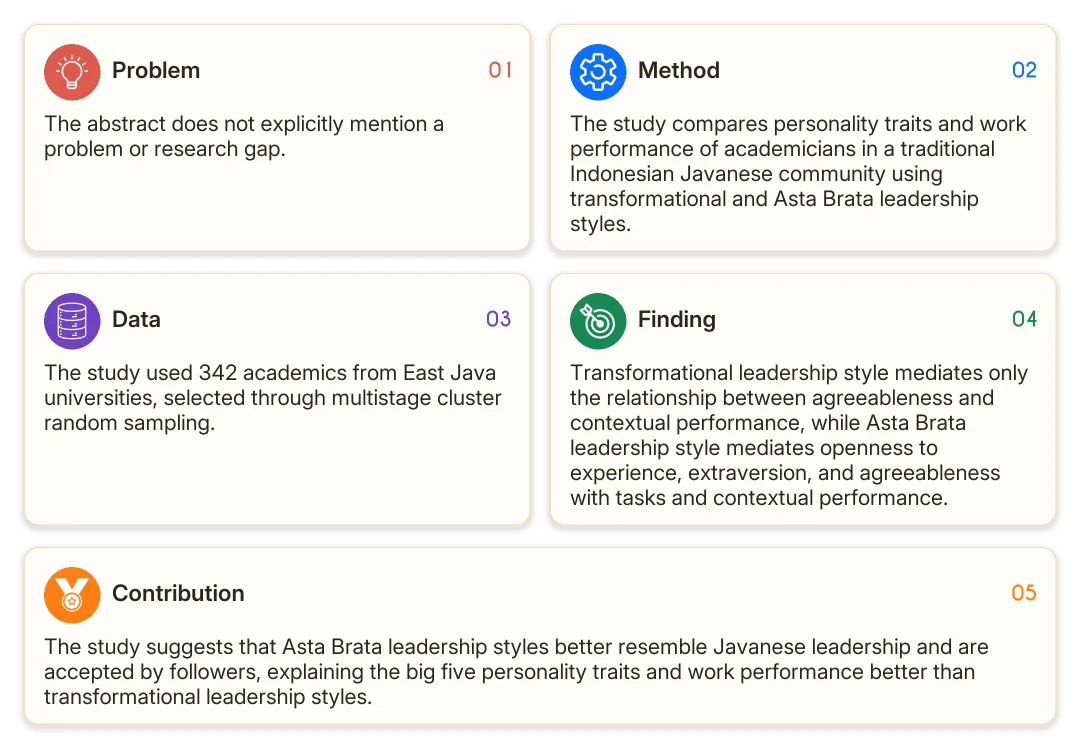
Asta Brata’s leadership styles explain the big five personality traits and work performance better than transformational leadership styles.
Details
Abstract
Psychologists have argued that Western-based explanations of personality traits, leadership styles, and work performance may not capture Eastern norms and values. This study compares academicians’ personality traits and work performance in a traditional Indonesian Javanese community using transformational and Asta Brata as western and Hindu philosophy of leadership styles scales, respectively. This study uses transformational and Asta Brata leadership styles to examine how leadership styles act as mediators between personality traits and work performance. The respondents were 342 academics from East Java universities selected using multistage cluster random sampling. The results showed that the transformational leadership style mediates only the relationship between agreeableness with contextual performance and openness to task performance. Asta Brata’s leadership style mediates openness to experience, extraversion, and agreeableness with tasks and contextual performance. In conclusion, academicians recognize that Asta Brata is better than the transformational leadership style as a mediator between personality traits and work performance. These data imply Asta Brata’s leadership approaches better resemble Javanese leadership and are accepted by followers than transformational leadership. Finally, Asta Brata’s leadership styles explain the big five personality traits and work performance better than transformational leadership styles. © 2024, Institute of Advanced Engineering and Science. All rights reserved.
Affiliations
Faculty of Psychology, Universitas Negeri Malang, Malang, Indonesia; Department of Educational Psychology and Counselling, Faculty of Education, Universiti Malaya, Kuala Lumpur, Malaysia; Department of Educational Management, Planning, and Policy, Faculty of Education, Universiti Malaya, Kuala Lumpur, Malaysia