Molten fluoride salt-assisted synthesis of titanium carbide (Ti2C) MXene and its application for 2 µm mode-locking in a thulium-doped fiber laser
Laser Physics Letters , Vol. 21 (8) · 2024
Summary
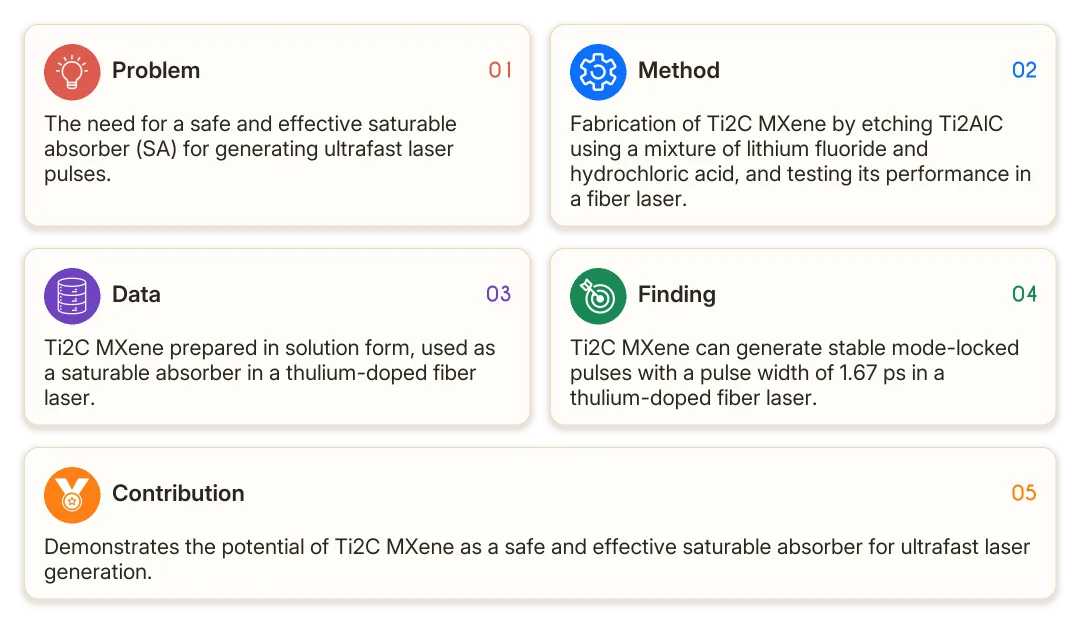
The Ti2C MXene exhibited outstanding performance for ultrafast laser generation in the thulium-doped fiber laser.
Details
Abstract
Titanium carbide (Ti2C), a new two-dimensional material named MXenes, has attracted interest due to its potential applications in numerous fields. Of the many unique characteristics of Ti2C MXene, its nonlinear properties are attractive for optoelectronic applications, specifically for ultrafast laser generation. In this work, a Ti2C MXene was fabricated by etching a MAX phase precursor titanium aluminum carbide (Ti2AlC) using a mixture of lithium fluoride and hydrochloric acid, eliminating the risk of using the harmful hydrofluoric acid. The Ti2C MXene was prepared in solution form and then dropped onto a reduced core diameter of tapered fiber before being used as a saturable absorber (SA). The SA device was inserted into a thulium-doped fiber laser to generate stable mode-locked pulses at a center wavelength of 1951 nm with a pulse width of 1.67 ps. The mode-locked laser was highly stable when tested over time, with peak optical power fluctuations of as little as 0.005 dB measured. The results show that the Ti2C MXene exhibit outstanding performance for ultrafast laser generation. © 2024 Astro Ltd.
Affiliations
Photonics Research Centre, Universiti Malaya, Kuala Lumpur, 50603, Malaysia; Physics Department, Faculty of Science, Universiti Malaya, Kuala Lumpur, 50603, Malaysia; Physics Department, International Islamic University Malaysia, Bandar Indera Mahkota Pahang, Kuantan, 25200, Malaysia; IIUM Photonics and Quantum Research Centre (iPQC), Kulliyyah of Science, International Islamic University of Malaysia, Bandar Indera Mahkota Pahang, Kuantan, 25200, Malaysia; Department of Physics, Faculty of Mathematics and Natural Sciences, Universitas Negeri Malang, Malang, 65145, Indonesia; Universiti Kuala Lumpur British Malaysian Institute (UniKL BMI), Batu 8, Jln Sungai Pusu, Gombak, Kuala Lumpur, 53100, Malaysia