Histological and physiological responses of Spodoptera litura F. larvae after exposure to papaya leaf extract (Carica papaya L.)
BIO Web of Conferences , Vol. 117 · 2024
Summary
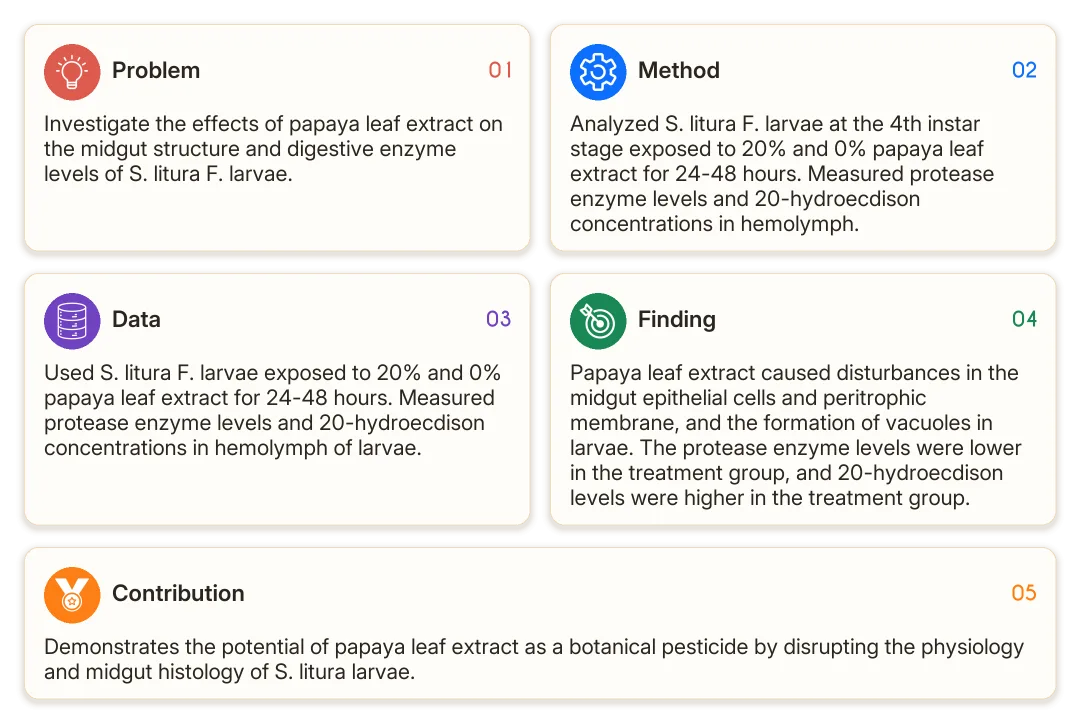
Papaya leaf extract can disrupt the physiology and midgut histology of S. litura larvae, suggesting its potential as a botanical pesticide.
Details
Abstract
This study aimed to analyze the histological structure of the midgut, levels of digestive enzymes, and concentrations of 20-hydroecdison in S. litura F. larvae after exposure to papaya leaf extract (PLE). This experimental study used S. litura F. instar 4th larvae exposed to 20% and 0% PLE for 24-48 hours. The larvae were dissected, and their intestines were taken to isolate intestinal protein and then to measure the levels of the protease enzyme. The larval histology was prepared by examining the larvae and taking part in the midgut of the larva measurement of 20-hydroecdison levels by isolating protein in hemolymph fluid. The results showed that the midgut epithelial cells of the control group were normal, while the larvae in the treatment group experienced disturbances, the disintegration of the peritrophic membrane, and the formation of vacuoles in the cells. The protease enzyme measurement results in the control group were 39.76 ng/ml lower than the treatment group (45.43-56.92 ng/ml). The 20-hydroekdison measurement results in the control group were 70.76 ng/ml lower than in the treatment group, which were 9060-22361.51 ng/ml. Based on the studya's results, PLE can disrupt the physiology and midgut histology of S. litura larvae, so that it can be developed as a botanical pesticide. © 2024 The Authors.
Affiliations
Department of Biology, Faculty of Mathematics and Natural Sciences, Universitas Negeri Malang, Malang, Indonesia; Department of Biology, Faculty of Mathematics and Natural Sciences, Universitas Brawijaya, Malang, Indonesia; Departement of Pest and Disease, Faculty of Agriculture, Universitas Brawijaya, Malang, Indonesia