Structural Damage Model of Steel Structure Connections with Initial Defects: A Review
Journal of Advanced Research in Applied Mechanics , Vol. 121 (1) · 2024
Summary
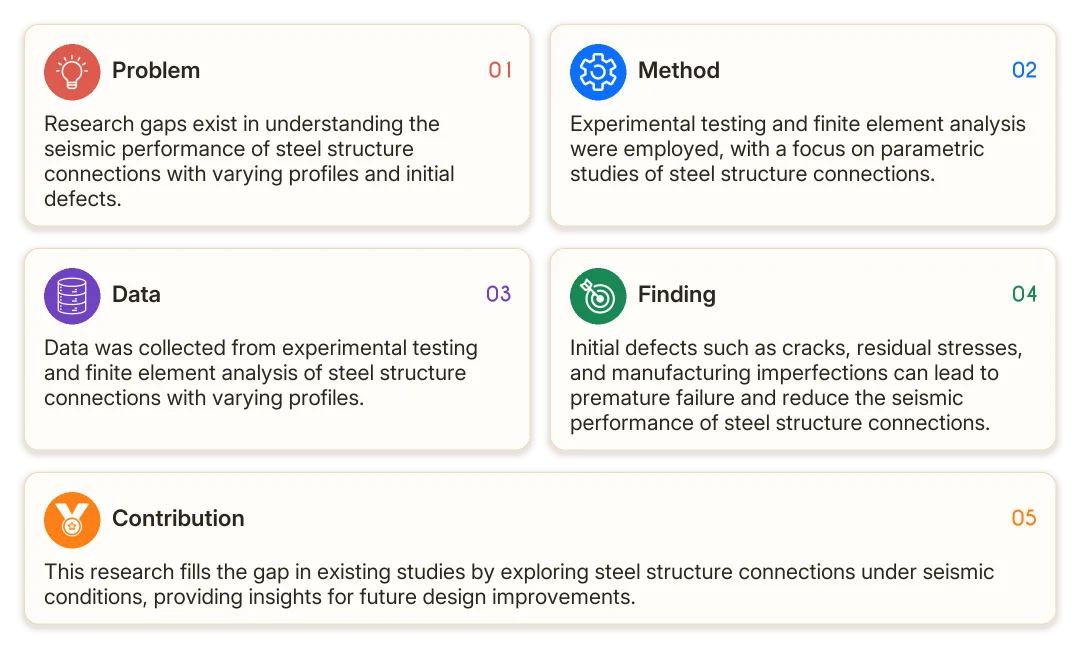
The presence of initial defects such as cracks, residual stresses, and manufacturing imperfections can lead to premature failure and reduce the seismic performance of steel structure connections.
Details
Abstract
As the application of steel structures in construction continues to grow, research into their seismic performance is becoming increasingly important. This paper focuses on steel structure connections, specifically those between components with varying profiles such as H-profiles, box-profiles, and L-profiles. Additionally, it encompasses three core areas: seismic performance (bearing capacity, ductility, stiffness), initial defects (initial cracks, residual stresses, manufacturing imperfections), and damage models (weld fractures, bolt failures, plate buckling). In addition, this paper employs experimental testing and finite element, with a focus on conducting parametric analyses for the connections. Based on the primary findings, the presence of initial defects such as cracks, residual stresses, and manufacturing imperfections can lead to premature failure, concentrating damage near welds and exacerbating stress concentrations. This adversely affects factors like fatigue strength, fracture toughness, and buckling strength, ultimately reducing the seismic performance of the connections. Moreover, factors like bolt over-tensioning, geometric deviations in plate components, and corrosion can further impact bearing capacity, fatigue performance, and ductility. Crucially, these initial defects not only compromise the seismic resistance of structures but also increase the risk of structural failure. However, majority of existing research has focused on monotonic and cyclic loading studies, with limited exploration of connections under seismic conditions. Acknowledging this gap, this paper outlines a future research agenda aimed at refining the design of steel structure connections. This initiative seeks to mitigate potential adverse consequences stemming from formidable seismic events, thereby enhancing the overall resilience of these crucial connections. © 2024, Semarak Ilmu Publishing. All rights reserved.
Affiliations
Department of Civil Engineering Technology, Faculty of Engineering Technology, Universiti Tun Hussein Onn Malaysia, Johor, Pagoh, 84600, Malaysia; Department of Civil and Architectural Engineering, Liming Vocational University, Fujian Province, Quanzhou City, 362000, China; Department of Civil Engineering, Universitas Negeri Malang, Jawa Timur, Malang, 65145, Indonesia